TL;DR
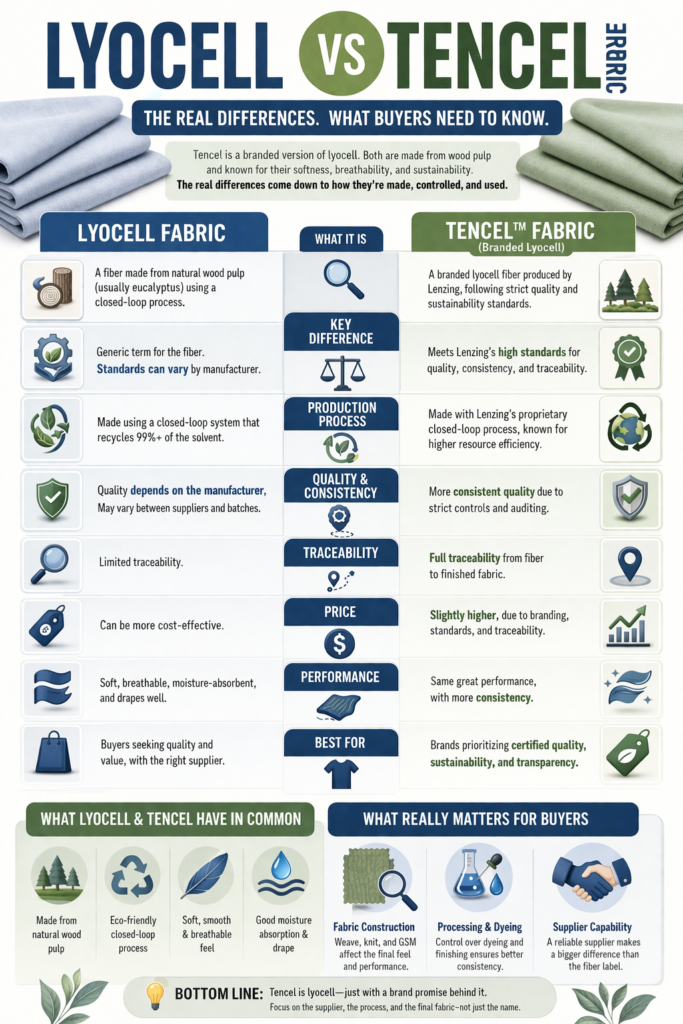
Lyocell and Tencel are essentially the same fiber, but Tencel is a branded version. The real difference for buyers comes from fabric construction, processing, and supplier control, not just the name. Sampling and consistency matter more than labels.
Check out our digital swatch collection here
Lyocell vs Tencel Fabric… Is There Even a Difference?
This question comes up more often than you’d expect. Buyers ask:
Is lyocell different from Tencel? Is one better than the other? Does it affect garment quality? Short answer? Not really. But also… it depends. Let me explain.
What Lyocell Actually Is
Lyocell is a type of fiber made from wood pulp, usually eucalyptus. It’s processed using a controlled method that’s considered more environmentally friendly compared to traditional viscose.
From a fabric point of view, lyocell is known for:
- soft hand feel
- smooth surface
- good moisture absorption
- breathable structure
It’s widely used in apparel that focuses on comfort and drape. If you’ve worked with it before, you’ll know it behaves quite differently from structured fabrics like those explained in dobby fabrics, where texture and pattern play a bigger role than flow.
Then What Is Tencel?
Tencel is not a different fiber. It’s a brand name. More specifically, it’s a branded version of lyocell produced under controlled processes. So technically:
- all Tencel is lyocell
- but not all lyocell is branded as Tencel
This is where confusion starts. Because buyers sometimes assume they are two separate materials. They’re not.
So Why Do Buyers Care About the Difference?
Even though the base fiber is the same, the difference comes from how it’s made and handled. Tencel-branded fibers usually follow stricter production standards.
That can lead to:
- more consistent fiber quality
- better traceability
- more predictable fabric performance
But here’s something I’ve noticed. Once the fiber is turned into fabric, the final result depends on much more than the fiber name.
Fabric Construction Changes Everything
This is where things get real. Two fabrics, both labeled as lyocell or Tencel, can behave very differently depending on:
- weave or knit structure
- GSM
- finishing
A lighter fabric might feel more fluid but wrinkle more. A tighter construction might hold shape better but feel less soft. This is similar to how construction affects other fabrics. For example, in cotton slub fabric, texture changes the entire look and feel even when the base fiber is cotton. Same idea applies here.
Dyeing and Processing Make a Bigger Difference
This is where most variations actually happen. Lyocell fibers absorb dye well, but they’re also sensitive. If the process is not controlled properly, you might see:
- shade variation
- surface marks
- slight streaking
And this applies to both lyocell and Tencel. The fiber name doesn’t prevent these issues.
Process control does. We’ve explained similar behavior in criteria for selecting dyes by fibre content, where fiber type affects dyeing, but handling determines the final result.
Handling Sensitivity Is Often Overlooked
This is something that doesn’t get enough attention. Lyocell-based fabrics are softer, but that also makes them more sensitive during processing.
You might notice:
- creasing during handling
- pressure marks
- surface changes
These are not defects exactly. They’re characteristics of the fabric. But if not managed properly, they affect the final garment.
Sampling Is Where the Difference Shows Up
If there’s any stage where “lyocell vs Tencel” actually matters, it’s during sampling.
Not because the fiber changes. But because this is where you evaluate how the fabric behaves. Buyers should check:
- drape and fall
- softness consistency
- behavior after washing
- color uniformity
Sometimes, fabrics look identical initially but behave differently after washing. We’ve seen this pattern in early-stage evaluations like those discussed in woven sample, where small differences show up later if not tested early.
Export Orders Raise the Stakes
When sourcing for export, expectations are higher. Buyers are not just looking at one batch.
They expect consistency across:
- bulk production
- color matching
- fabric feel
And this is where differences in process become more important than fiber branding.
We’ve seen similar challenges in sourcing scenarios like those explained in why buyers struggle with Indian woven fabric exporters, where coordination issues affect outcomes more than material choice.
Production Planning Still Plays a Role
Even with premium fibers like lyocell or Tencel, production is not a single step.
It involves:
- yarn preparation
- weaving or knitting
- dyeing
- finishing
If one stage shifts slightly, the final fabric changes. I’ve seen cases where finishing adjustments slightly changed the hand feel between batches. Not drastic. But noticeable if you compare side by side.
So… Which One Should You Choose?
This is where the answer gets practical. If you’re choosing between lyocell and Tencel, the better question is: Who is producing the fabric? How controlled is the process? How consistent are the samples? Because in most cases:
- a well-processed lyocell fabric performs better than poorly handled Tencel
- a strong supplier matters more than the label
For example, even with fabrics that seem simple, like seersucker fabric, consistency depends more on process than fiber type. Same applies here. At Dinesh Exports, the focus is on controlling the process so what you approve in sampling is what you get in bulk.
Final Thoughts
Lyocell and Tencel are not competing materials. They’re essentially the same fiber.
The real difference comes from:
- how the fabric is constructed
- how it’s processed
- how consistent the supplier is
Once you understand that, the confusion disappears. And sourcing becomes a lot simpler. If you are looking for a reliable woven fabric manufacturer for your lyocell and tencel fabric, please contact us.
Frequently Asked Questions
Is Tencel the same as lyocell?
Yes, Tencel is a branded version of lyocell fiber.
Which is better, lyocell or Tencel?
Both are similar. The final fabric quality depends more on processing and construction.
Why is Tencel more expensive?
Because it is produced under controlled and branded conditions.
Is lyocell fabric sustainable?
Yes, it is considered eco-friendly due to its production process.
Does Tencel perform better than lyocell?
Not necessarily. Performance depends more on fabric processing than branding.